Showing posts with label film review. Show all posts

Monday, 10 March 2014

Film Review: Memento (2000)

Extra Large Movie Poster Image for Memento
Fig 1.


Christopher Nolan's Memento (2000) is a complex film that explores the use of story telling within a film. It consists of two different sequences one being black and white that is shown in order and the other in colour that is shown in reverse order these then meet to reveal to overall story at the very end. Memento is a film that is shown from Leonard's perspective and he is a sufferer of short term memory loss that he sustained after his wife's murder. He can now only live by taking Polaroid images and getting tattoo's on his body to remind of the events or facts that he can use to retrace the murderer of his wife (Fig 2.)
http://alwaysbatman.files.wordpress.com/2012/05/protectedimage-php.jpg
Fig 2.


Memento (2000) is a physiological film leads the audience into the mind of Leonard who has short term memory loss. It represents Leonard's disorientation quite brilliantly with the use of editing throughout the film this is explained by A. O. Scott in his film review, ''Each scene jumps back in time, and ends where the previous one -- in narrative time, the next one -- began.'' ( A.O. Scott, 2001). Therefore this notion of jumping back in time and telling the story in reverse it gives the audience a sense of what Leonard feels like to have short term memory loss. 

One of the great mysteries within the film is how Leonard has managed to get all of his money, a Jaguar car and a tailored name make suit when he has no job and is mentally ill.Throughout the film as an audience member you are always questioning what and who you can rely on to tell the story. In Memento you are consistently lead to believe one thing is correct to then find out that it is not what it is made out to be. This is shown clearly in the scene with Leonard and Natalie when they are in Natalie's flat (Fig 3.). Before this encounter we are lead to believe that she has been beaten up by a drug dealer who wants money for the drugs that he is owed; but after we are shown what really happens between Leonard and Natalie. She was insulting Leonard and says how she is going to use him to do her dirty work and Leonard hit her resulting in the injuries. Consequently we as an audience are questioning what to rely on when trying to figure out the narrative for this film. Angie Errigo talks about the unreliable narrator within her film review,  ''Nolan's simple stroke of genius was to add the old literary trick of an unreliable narrator and thereby kick away the last remaining prop an audience could rely upon'' (Errigo, s.d).


fig 3.
The film manages to disorientate the viewer many times throughout the film and with its unusual backwards storytelling narrative has a unique play on the thriller genre. This film is more a physiological thriller that plays on the audience's state of mind, this was said in the Roger Ebert's film review, ''The movie doesn't supply the usual payoff of a thriller (how can it?), but it's uncanny in evoking a state of mind.'' (Ebert. 2001). What Ebert appears to be saying is that it does not follow the usual conventions of a thriller and does not give the same results that a thriller usual gives. Overall Memento is not your regular thriller and Christopher Nolan constructed it in a highly intelligent way to make the audience connect with how Leonard is feeling with his condition and although going against most conventional narrative structures it is hugely successful in its execution of cinematography.  

Illustration List:

Fig 1.[Film Poster] Memento (2000), Directed by Christopher Nolan. At: http://www.impawards.com/2001/memento_xlg.html (Accessed on 10.03.2014)

Fig 2. [Film Still] Memento (2000), Directed by Christopher Nolan.
At: http://alwaysbatman.files.wordpress.com/2012/05/protectedimage-php.jpg (Accessed on 10.03.2014)

Fig 3. [Film Still] Memento (2000), Directed by Christopher Nolan.
At: http://movieimage1.tripod.com/memento/memento11.jpg(Accessed on 10.03.2014)

Bibliography:

A.O. Scott (2001), Film Review; Backward Reel the Grisly Memories 
At: http://www.nytimes.com/movie/review?res=9E06E5DC173DF935A25750C0A9679C8B63&partner=Rotten%2520Tomatoes (Accessed on 10.03.2014)

Errigo, A. (s.d), Film Review, Memento.
At: http://www.empireonline.com/reviews/ReviewComplete.asp?FID=6255 (Accessed on 10.03.2014)

Ebert, R. (2001), Film Review, Memento.
At: http://www.rogerebert.com/reviews/memento-2001 (Accessed on 10.03.2014)


Wednesday, 26 February 2014

Film Review: Jaws (1975)

Fig 1
Steven Spielberg's 1975 Jaws is based upon Peter Benchley's best selling novel of which has the same name. It is a classic man vs nature film with the big man eating shark being the nature object. Similarly to Psycho, Jaws consists of little music throughout and is still renowned for one of the most famous sounds in film history with the strings its instantly recognizable and as an audience we associate that sound of the strings with fear, suspense and ultimately - Jaws. From the very begging we are filled with dramatic music and this is said by B. H. Martin in his Jaws review, ''Jaws begins in the darkness of the deep ocean. Before we see anything, our ears are chilled by composer John Williams' menacing two note soundtrack which then builds into that unforgettable frenzy as the unseen shark savages its first victim.'' (Martin, 2012). With the menacing sound track creating tension the audience knows what is about the happen when the shark is approaching (Fig 2.), but is it is done in such a way that you can feel it through the music before the action has happened in front of you.


Fig 2.


Gene Siskel says in his review of Jaws that the characters are not important within the film as that is not the focus of the film when it was being made, he says: ''So far I've managed to avoid describing the story or any of the humans involved in it. That's because what this movie is about, and where it succeeds best, is the primordial level of fear.'' (Siskel, 1999). What Siskel seems to be saying is that the characters do not play an important role within the film but rather the whole film evolves around its soundtrack and the fear it creates within the audience. When looking at Jaws  the none suspense shots and the overall character building is weak in comparison to music composition and anticipation shots, this is where Jaws really shines and why it is well known for its tension caused throughout the film.
http://flavorwire.files.wordpress.com/2011/07/june2011finalimagejaws.jpg?w=600&h=335
Fig 3.
During the film the shark was see to be represented by floating objects or camera angles that make the audience believe that they are viewing from the sharks perspective (Fig 3.). This was explained in Rodger Ebert film review of Jaws, ''Floating objects are used all through the movie to suggest the invisible shark.'' (Ebert, 2000) this was mainly due to the technical difficulties they had with the shark operating on set because of the difficulties that they encountered this was more of a reason to have a recognizable sound that you can associate with the shark so the audience knows what to expect when hearing the dreading violins and orchestra in the background. With the soundtrack being one of the most notorious sounds that you will hear throughout the film industry. Although this film is not the best at character development the use of sounds and the suspense caused throughout is to be desired in the film industry.

Illustration List:

Fig 1. [Film Poster] Jaws (1975), Directed by Steven Spielberg. 
At: http://www.blog.sharkcagediving.co.za/wp-content/uploads/2013/10/jaws-movie-poster.jpg (Accessed on 25.02.2014)


Fig 2. [Film Still] Jaws (1975) Directed by Steven Spielberg.
At: http://www.youtube.com/watch?v=GNmYEg3aLds#t=44 (Accessed on 25.02.2014)

Fig 3. [Film Still] Jaws (1975) Directed by Steven Spielberg.
At: http://flavorwire.files.wordpress.com/2011/07/june2011finalimagejaws.jpg?w=600&h=335 (Accessed on 26.02.2014)

Bibliography:

Martin, B. (2012) Jaws is Back - Review

At: http://www.u.tv/blogs/B-H-Martin/Shark-Attack-Jaws-Is-Back/01dadc82-fc82-49f0-bbd6-88f09371c29d (Accessed on 25.02.2014)

Siskel, G. (1999) Jaws Movie Review
At: http://articles.chicagotribune.com/1999-10-15/entertainment/9910200025_1_movie-reviews-star-film/2 (Accessed on 26.02.2014)

Ebert, R. (2000) Jaws (1975) Film Review
At: http://www.rogerebert.com/reviews/great-movie-jaws-1975 (Accessed on 26.02.2014)

Tuesday, 25 February 2014

Film Review: Pyscho (1960)

poster, 1960
Fig 1.
Psycho directed by Alfred Hitchcock in 1960 is a story that was hugely inspired by a serial killer in 50's - Edward Theodore Gein. Psycho was not a high budget film and was deliberately shot to make it look like a cheap exploration film to help build the tension and suspense for the audience. To keep the price low Hitchcock chose to shoot the film in black and white even though colour was available with in combination working with one layer of sound throughout the film. Its unique violin screech in the shower scene makes an unique viewing experience that leaves the audience with a memory of Psycho. Rodger Ebert talks about Hitchcock's directing decisions when creating the shower scene, ''Seeing the shower scene today, several things stand out. Unlike modern horror films, "Psycho" never shows the knife striking flesh. There are no wounds. There is blood, but not gallons of it.'' (Ebert, 1998). Hitchcock did not believe in showing gore but using suspense and the notorious sound  of screeching violins to represent the crime in the shower (Fig 2).


Fig 2.
 The use of screeching violins is not only reflected in the shower scene but the notion of tearing resonates throughout the whole film too. The long screeches and winding chords reflect the suspense and madness that the audience is going to witness throughout the film this is said by Rob Nixon,“Herrmann wrote the main title theme for Psycho before Saul Bass created the opening credit sequence. Bass animated it to the music, creating the stabbing, wrenching look in which the credits are ripped in half.” (Nixon, 2014). Throughout the film Hitchcock is always referring back to the notion of discomfort for the audience and this is even shown through the credits of the film too reminding you of the shower scene murder with the grey lines representing the shower curtain and the words 'psycho' seemingly being sliced in half.(Fig 3.).

https://blogger.googleusercontent.com/img/b/R29vZ2xl/AVvXsEji7nbualxqVg7klTdctwfjtFM6ihtqApkKmTKVFXSjEaSRhKv4aLzxdD9zmd4Mxohaj4dbEdxhlx6bV2AF20I4WPt-icftXuYDw6M3Yrlt4xX2yTtj8roMVbFdp2nQFqtGdIcWQWyz7Ww/s1600/Psycho_Saul+Bass.jpg
Fig 3
 Bernard Herrmann was the music music composer for the Psycho he did not only follow each scene beat for beat he found a way to convey the emotions of the characters through the music within the film, Chris McEneany goes into some detail about the sounds within Psycho he states, ''His music told the same story but from an instinctual standpoint that served to join the dots and fill in the blanks - although in much too subtle and intelligent a manner than to merely blurt out the details.'' (McEneany, 2010). It appears that what McEneany is saying is that Psycho is told in two separate stories one from a visual standpoint and one from a musical view. Psycho is a classic film where music and visuals harmonies into a perfect viewing experience leaving you feeling unsettled with a killer performance.


Illustration List: 

Fig 1. Psycho [Film poster], Directed by Alfred Hitchcock. At: http://johneaves.files.wordpress.com/2013/03/psycho-theatrical-release-poster-1960.jpg (Accessed on 24.02.2014)

Fig 2.  [Film still], Directed by Alfred Hitchcock. At: http://fogsmoviereviews.files.wordpress.com/2011/07/pyscho4752.jpg (Accessed on 25.02.2014)

Fig 3.  [Film still], Directed by Alfred Hitchcock.At: https://blogger.googleusercontent.com/img/b/R29vZ2xl/AVvXsEji7nbualxqVg7klTdctwfjtFM6ihtqApkKmTKVFXSjEaSRhKv4aLzxdD9zmd4Mxohaj4dbEdxhlx6bV2AF20I4WPt-icftXuYDw6M3Yrlt4xX2yTtj8roMVbFdp2nQFqtGdIcWQWyz7Ww/s1600/Psycho_Saul+Bass.jpg (Accessed on 25.02.2014)


Bibliography:

Ebert, R. 1998. Psycho Review. 
http://www.rogerebert.com/reviews/great-movie-psycho-1960 (Accessed on 25.02.2014)

Nixon, R. (2014) Behind the camera on Psycho.
At: http://www.tcm.com/this-month/article/191164|0/Behind-the-Camera-Psycho.html (Accessed on 25.02.2014)

McEneany, C. 2010. Psycho - Complete Original Motion Picture Score Soundtrack Review.
At: http://www.avforums.com/review/psycho-complete-original-motion-picture-score-soundtrack-review.1476 (Accessed on 25.02.2014)


Monday, 24 February 2014

Film Review: Rope (1948)

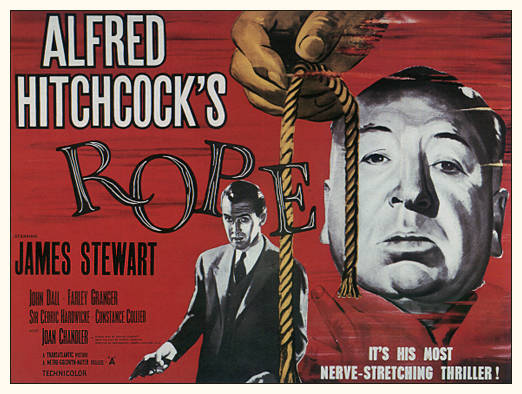
Fig 1


Rope is a classic thriller directed by Alfred Hitchcock in 1948. The film does not consist of any editing that you would see in modern films and the acting is naturalistic which leads the audience to believe that what they are seeing is in real time. That is not to say that there is not editing within Rope, there is, just not as much editing you would see other films that rely on editing to get the narrative across. It is directed in a way which you would consider it to be a continuous film and it was filmed in this way to represent the qualities of theater on a screen production.  It was a challenge for the director to get across the quality of a theater production on play screen and this was said in the New York Times by Vincent Canby, ''Hitchcock was interested in seeing whether he could find a cinematic equivalent to the play, which takes place in the actual length of time of the story'' (Canby, 1984). The breaks that usually occur within Rope  are done by panning across someone's back to a dark frame where he would cut the film and replace it with another. The result of a film that doesn't use the use of conventional montage by cutting from one frame to another gave the film an unusual, eerie feel to it, which is suited to the overall film.

Rope is an 80 minute film that is made out to be longer with its theater qualities to it, the set was built with this in mind Arbunkle explains the use of set design in his review, “In Rope, (Hitchcock) used a set with walls built on wheels so that he could have the cameras move unimpeded around the film’s group of three rooms.” (Arbunkle, 1999). This helps Hitchcock keep the sense of a continuous film coupled with realistic New York city backgrounds and you have a setting that is convincing of being in real time (Fig. 2). 


Fig 2.
The long takes that give the film a sense of continuation also can give a sense of suspense as Fernando F. Croce states, '' Far from just "recording a play," the suffocating long takes enforce ethical contemplation by refusing the relief of a cut '' (Croce, 2006) this is shown in the scene with the maid when she is preparing the coffee table with the body inside (Fig 3.) 
With the use of a contiguous shot and one point perspective the audience is led to focus on the situation that is about to happen. An example of this is when the maid and Rupert are staring at the box with Dave inside creating a sense of tension and suspense. Hitchcock uses a technique where the audience has more information than the characters, within Rope the audience know about the body inside the box where the characters are completely oblivious to the situation. 


Fig 3.


Illustration List:


Fig 3. Rope [Film Still], From Rope - Directed by: Alfred Hitchcock. At:https://blogger.googleusercontent.com/img/b/R29vZ2xl/AVvXsEjKSEX3G6v1D24Rax6_OwI7TJAoWMCsS9AVM8teYzu4sEDjYFOtUs-7nu0k73s7D0JNKlPzL9UOOqjlOeLCpgBGcspuzx87cHIDfFcuv2hHU-stI5xQGErfQS3PnSpInwHVDTbPr8UOycs/s1600/Rope+tense+chest+scene.jpg (Accessed on 24.02.2014)


Fig 2. Rope From Rope - Directed by: Alfred Hitchcock
http://i2.wp.com/www.filmophilia.com/wp-content/uploads/2013/03/4711.jpg (Accessed on 24.02.2014)

Fig 1. Rope Poster(1948) From: Rope – Directed By: Alfred Hitchcock.
At: http://derekwinnert.com/wp-content/uploads/2013/11/679.jpg (Accessed on 21.01.2014)

Bibliography:
Canby, V. 1984, Rope - Film Review: [online]
At:  http://www.nytimes.com/library/film/060384hitch-rope-reflection.html (Accessed on 21.01.2014)

Arbunkle, W. (1999) Hitchcock's Film Interiors: Home Is Where The Knife Is
http://www.thewag.net/film/hitch.htm (Accessed on 24.012014)

Croce, F. 2006, Rope - Film Review: [Online]
At: http://www.slantmagazine.com/dvd/review/rope/948 (Accessed on 24.02.2014)


Monday, 25 November 2013

Film Review: Edward Scissorhands

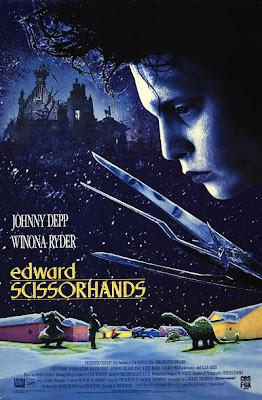
https://blogger.googleusercontent.com/img/b/R29vZ2xl/AVvXsEgv6uT7aYNZbIqarXsfEbaeGXiY-hd8blNwMHVoiz0tYsPgy0-4nWZEUjLklnj2V4MOduis6yi91QHoxWTuNwrBeGFb_8o7BCf3hqv-Tto5gpFacYp4YF0EiLIpj6Xdd_dpmVPME8fX8Ts/s1600/ES+poster.jpeg
(Fig 1, Edward Scissorhands, Poster)

 Tim Burton's film Edward Scissorhands (1990) was one of his most renowned films with lead actor Johnny Depp playing Edward. Edward Scissorhands  could be argued that it gave you an insight into the world of Burton's childhood. Edward was heavily influenced upon how Burton had felt within his life - the outsider, the misunderstood. Although asperges was not recognized until 1940, according to Helena Bonham Carter had said in an interview: ''I realised he has a bit of Asperger's in him. You start recognising the signs. We were watching a documentary about autism and he said that was how he felt as a child.''( Carter, 2010). The film was created show his seperation from society and showing the world through another perspective. It had created an iconic figure for individuality and to stand out among the crowds through one character alone - Edward. This is one of the most iconic figures of today and has had a huge influence upon the fashion scene and it had all started from a drawing from his childhood (Fig. 2).
(Fig 2. Edward Scissorhand original illustration).


Throughout the film the separation between worlds with Edward and his surroundings is obviously represented through character, but also through scenery too. The film is set in a suburban American town and in the 1950's to 60's. When introduced to the film we are given a one point perspective shot showing the two extreme's of Edward's house and the surrounding area (Fig 3).
https://blogger.googleusercontent.com/img/b/R29vZ2xl/AVvXsEjKwJkqb-mNTcrpc52nPW_8eea9lzkk4jGQ6S_JZlcUFjUmmFQ0e9sGQNFWp7jM0mwmvMNNM6Ia7HrYKEaeNU2PUqmAimEFt2Gqaf3Pci36rIH_Jyyddbt9xkZxn7rtznzX-9bRFa0DVx9L/s320/esc_014Neighborhood.jpg
(Fig 3, Edward Scissorhands, Film still)
Although Tim Burton is not known for one the use of one point perspective, Stanley Kubrick is and known famously for the use of these techniques. As Lauren Davis had said whilst analyzing Kubrick's techniques: ''One thing that makes Kubrick's movies so unusual is his heavy use of one-point perspective, to focus in on a single character or object, and often to create a sense that we are trapped within the scene rather than merely watching it.''(Davis, 2012). Furthermore this could be argued that we as an audience are trapped within the scene and feeling the emotions that Edward is feeling. Not only is Edward physically trapped within the castle and 'locked' away from the outside world but he is also emotionally trapped inside a body that no one understands, as an audience we are given that understanding which therefore allows us to relate to Edward. 

Altogether throughout the film there seems to be a constant clash between the two opposites, even in the times where he is accepted as part of the 'normal' community he is seen as being used for his abilities rather than being acknowledged for who he is. This was a film which Tim Burton wanted you to see through his eyes in a fantasy environment. With the fantastic set design and character development you can clearly see Tim Burton had payed close attention to all the little details to get across this complexity of messages for the audience to embrace.


Bibliography:

(Carter, 2010), Mr and Mrs Mad Hatter, Daily Mail [Article]. URL:
http://www.dailymail.co.uk/tvshowbiz/article-1253885/Mr-Mrs-Mad-Hatter-The-strange-world-Helena-Bonham-Carter-Tim-Burton.html (Accessed 25.11.2013)


(Davis, 2012), How obsessed was Stanley Kubrick obsessed with one point perspective? [Online Blog], at URL: http://io9.com/5939802/just-how-obsessed-was-stanley-kubrick-with-one+point-perspective-watch-this-video-to-find-out (Accessed, 25.11.2013)

Illustration list:

Fig 1, Edward Scissorhands (1990) [Poster], URL: https://blogger.googleusercontent.com/img/b/R29vZ2xl/AVvXsEgv6uT7aYNZbIqarXsfEbaeGXiY-hd8blNwMHVoiz0tYsPgy0-4nWZEUjLklnj2V4MOduis6yi91QHoxWTuNwrBeGFb_8o7BCf3hqv-Tto5gpFacYp4YF0EiLIpj6Xdd_dpmVPME8fX8Ts/s1600/ES+poster.jpeg (Accessed 25.11.2013)

Fig 2. Edward Scissorhands (1990), Original illustration [Illustration], at URL: http://www.stylenoir.co.uk/wp-content/uploads/2011/06/Edward-Scissorhands-tim-burton-original-illustration.jpg (Accessed on 25.112013)

Fig 3. Edward Scissorhands (1990), Directed by Tim Burton, [Film Still]. at URL: https://blogger.googleusercontent.com/img/b/R29vZ2xl/AVvXsEjKwJkqb-mNTcrpc52nPW_8eea9lzkk4jGQ6S_JZlcUFjUmmFQ0e9sGQNFWp7jM0mwmvMNNM6Ia7HrYKEaeNU2PUqmAimEFt2Gqaf3Pci36rIH_Jyyddbt9xkZxn7rtznzX-9bRFa0DVx9L/s320/esc_014Neighborhood.jpg. (Accessed on 25.11.2013)


Film Review: La Belle et la BĂȘte


(Fig 1: La Belle et la BĂȘte Poster)

La Belle et la BĂȘte is a french film in black and white directed by Jean Cocteau. It is an adaptation of a classic children's story by Mme and is well known as the Beauty and the Beast. As said by Michael Wilmington in his review, ''This is a poet-painter's film. In a glistening landscape that suggests Dutch paintings come to life.'' (Wilmington, 2002). On first sight this film looks incredibly stylized with its stunning production design.
http://theredlist.fr/media/database/settings/cinema/1940-1950/beauty-and-the-beast/023-beauty-and-the-beast-theredlist.jpg
(Fig. 2: La Belle et la BĂȘte, Production Art)


(Fig 4, La Belle et la BĂȘte, film still)


The film is highly influential from the original production art created for the sets as you can see in Figure 2. Cocteau had commended Beard on his influence upon the film as they worked together and from the concept and production art you can see a direct correlation to the costumes, lighting and the interior of the beast's castle. The film itself represents the artists visions when designing the sets with the gleaming white curtains and overall design of the house.

Produced in 1946 after World War Two this was hugely success with it's sense of escapism for the audience as this allowed the audience to break free from the reality of their tragedies and indulge themselves in a magical land. This was said in a written review by Frocktalk,“La Belle et La BĂȘte is a soothing balm of a fairy tale, engendering hope in the promise of new beginnings and restoring faith in the compassionate spirit of humankind. It is a story about breaking free from imprisonment and breaking forth into freedom. It was a message that people needed to hear then''(Frochtalk, 2009). This can be seen in the film where Belle falls in love with the beast after being 'imprisoned' by him but this also gave her a chance of a new beginning with a better life. 

(Fig 5,La Belle et la BĂȘte, Film still)


(fig 6, La Belle et la BĂȘte, Film still)


To help this sense of escapism within his film, Cocteau wanted to produce something out of the ordinary. This is shown with statues that are living and breathing (Fig 5) and candles being held with prosthetic limbs (fig 6). It is clear that he had put a lot of thought into each element: set design, costumes, plot etc. Altogether this is a film with great designs and a very strong underlining meaning to the film that was highly thought about at the time of production.


Bibliography:

(Wilmington, 2002), La Belle et la BĂȘte film review. URL: http://articles.chicagotribune.com/2002-09-06/entertainment/0209060033_1_beast-josette-day-magical. (Accessed on 22.11.2013)

(Frocktalk, 2009) La Belle et la BĂȘte film review. URL: http://frocktalk.com/?p=1520
(Accessed on 22.11.2013)


Illustration List:

Fig. 1: La Belle et la BĂȘte Poster Art (1946), From: La Belle et la BĂȘte, directed by: Jean Cocteau. [Poster] At: http://theredlist.fr/wiki-2-20-777-786-view-1940-1950-profile-1946-bbeauty-and-the-beast-la-belle-et-la-bete-b-j-cocteau-c-berard-l-carre-r-moulaert.html(Accessed on 22.11.2013)

Fig. 2: Drawing by Christian Beard (1946), For: La Belle et la BĂȘte, directed by: Jean Cocteau [Drawing]. At: http://theredlist.fr/media/database/settings/cinema/1940-1950/beauty-and-the-beast/023-beauty-and-the-beast-theredlist.jpg (Accessed on 22.11.2013)

Fig. 4.  La Belle et la BĂȘte film still (1946) From: La Belle et la BĂȘte, directed by: Jean Cocteau. [Film Still] At: http://dudummesau.com/2011/09/11/klaus-kinski-call-me-beast/ (Accessed on 22.11.2013)

Fig 5,La Belle et la BĂȘte, Film still (1946), From: La Belle et la Bete, directed by Jean Cocteau. [Film Still] At: http://www.gwarlingo.com/2012/jean-cocteau-beauty-and-the-beast/

Fig 6,La Belle et la BĂȘte, Film still (1946), From: La Belle et la Bete, directed by Jean Cocteau. [Film Still] At: http://www.gwarlingo.com/2012/jean-cocteau-beauty-and-the-beast/


Wednesday, 25 September 2013

The Cabinet of Dr. Caligari (1920) Review


This review examines the film, The Cabinet of Dr. Caligari (1920) directed by Robert Wiene. The Cabinet of Dr. Caligari is an impressionistic horror film made in the silent move era and was

Throughout the years The Cabinet of Dr. Caligari had been very inspirational and influential to many other films due to its stylistic approach to film making. Most films in the 1920's had the tendency to capture reality, whilst Dr. Caligari did quite the opposite with its expressionistic approach. ''The 1920s were the decade that saw the rise of the Dada and Surrealist movements''[1]. This film showed a clear inspiration from the surrealism movement and alongside the German Expressionism with its abstract environments that almost looked like pieces of art work used as scenery. Although it is mainly art work and script writing that had big impact on the surrealism movement it looks like films such as Dr. Caligari had also moved in that direction too.


With this approach of surrealism being brought into the film it had a very unique approach to the environments. It seemed to be derived from original art works with big bold strokes, pointy grass, sleeping windows and jagged buildings. Frame this alongside dark atmosphere and interesting characters and you have yourself a very unique horror movie that does not seem a decay old at all. Whilst watching this movie I had several flashbacks of the more recently released movie Shutter Island(2010). Shutter Island seemed to have the same plot but without the same stylistic approach. This reinforces how era's can have an affect on how a film is approached, whilst we are in the era of special effects and realism they were focusing more on abstractness and symbolism; which raises the question which leads to a stronger and more unique viewing experience?

"Caligari" is said to be the first example in cinema of German Expressionism, a visual style in which not only the characters but the world itself is out of joint''.[1] Throughout the film it was clear that it was not set in a real time world. Rather it was set in the mind of the mentalist. This gave them the creative freedom to produce a world that was not of the norm and allowed this whole film a sense of non-normality to it hybridising fiction and non fiction. It was clear it was a film that was not suppose to be enjoyed for pleasure but to make you think and understand the situation that German people were left in after the first world war. It was even lead to believe that Caligari was a representation of Hitler and the germans where all his sleepwalkers under his spell in the book ''From Caligari to Hitler''. Although this was before Hitlers time it is always interesting to see connections between German expressionism films and the lead up to Hitlers rising.


Being part of the artistic movement allowed Dr. Caligari to approach this film with more of an artistic influence to it. After seeing the concept art you realise just how accurate this film is to art itself. This had inspired many other artists through the years, Tim Burton being one of the most noticeable artists and although the plot it self was not unsettling it was the surrounding environment and characters transform it into something weird. This made for a unique experience and it can show simply how simple set design and character design with the right execution can make for a very powerful experience indeed. It must of taken an excellent mind to bring this all together and to extract all the metaphors and meanings behind this revolutionary production would take a life time. Although this being a black and white film it was way above its time and even now in-between all the special effect hyper realism films being produced today this film should not be missed for pure quality of the production.


[1] http://www.rogerebert.com/reviews/great-movie-the-cabinet-of-dr-caligari-1920